.png)
Cloud Computing is becoming one of the most important technology foundations in the digital transformation process of businesses. Instead of making significant investments in physical server systems, businesses can flexibly use computing resources, storage, databases, and technology services over the Internet.
Not only does Cloud Computing help optimize costs and infrastructure, but it also enables businesses to quickly deploy applications, scale their operations, and adapt to market changes.
So, what is Cloud Computing? Why does cloud computing play such an important role in digital transformation?
Let’s explore these questions in the following article.
1. What Is Cloud Computing?

Cloud Computing, or cloud computing technology, is a model that provides technology resources and services over the Internet, instead of requiring businesses to build and operate their entire physical infrastructure themselves.
Common resources provided through Cloud Computing platforms include:
- Servers and computing power.
- Data storage.
- Databases.
- Networks and security systems.
- Software development and deployment tools.
- Business software and applications.
- AI, Machine Learning, and data analytics services.
With Cloud Computing, businesses can use resources according to their needs and typically pay based on their actual usage. This helps reduce dependence on physical infrastructure while increasing scalability.
2. Why Has Cloud Computing Become the Foundation of Digital Transformation?
Digital transformation is not simply about moving traditional processes to an online environment. Businesses need to build a technology foundation that is flexible, scalable, and capable of connecting data.
Cloud Computing effectively meets these requirements.
2.1. Flexibility in Technology Deployment
With traditional infrastructure, businesses often need to purchase servers, network equipment, and software before deploying a new system. This process can take a considerable amount of time.
Meanwhile, Cloud enables businesses to quickly provision the necessary resources and put systems into operation. This is particularly useful for businesses that are testing new products or deploying technology projects within a short timeframe.
2.2. Scalability Based on Demand
One of the key advantages of Cloud Computing is its scaling capability.
When the number of users increases, businesses can expand their server resources. When demand decreases, resources can be adjusted to avoid unnecessary waste.
This capability is particularly important for:
- E-commerce.
- Fintech.
- SaaS.
- Mobile Applications.
- Digital Banking.
- Platforms with fluctuating traffic.
2.3. Infrastructure Cost Optimization
Building a dedicated Data Center requires businesses to invest in servers, storage systems, networks, electricity, cooling systems, and operations teams.
Cloud Computing can significantly reduce the initial investment required. Instead of making a large CAPEX (Capital Expenditure) investment, businesses can shift to an OPEX (Operating Expenditure) model and use resources according to their actual needs.
2.4. Supporting Remote Work
Cloud enables data and applications to be accessed from different locations, provided that users have the necessary access permissions and an Internet connection.
This is an important factor when businesses adopt:
- Remote Work.
- Hybrid Work.
- Distributed Teams.
- Global Collaboration.
Employees and IT teams can work on the same systems without necessarily being physically present in the office.
3. Common Cloud Computing Models
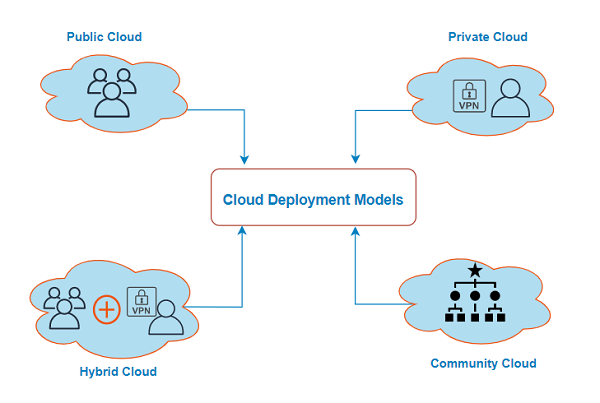
Cloud Computing is commonly classified based on deployment models and service models.
3.1. Public Cloud
Public Cloud is a model in which Cloud infrastructure is provided by a service provider, and multiple customers can use resources on that platform.
Some popular Public Cloud providers include:
- Amazon Web Services (AWS).
- Microsoft Azure.
- Google Cloud.
- Oracle Cloud.
Public Cloud is suitable for many businesses thanks to its fast deployment, easy scalability, and reduced need for significant investment in physical infrastructure.
3.2. Private Cloud
Private Cloud is a Cloud environment designed exclusively for a specific business or organization.
This model is often chosen when a business has high requirements for:
- Security.
- Data control.
- Regulatory compliance.
- Infrastructure control.
3.3. Hybrid Cloud
Hybrid Cloud combines Public Cloud and Private Cloud or On-premise infrastructure. This model is chosen by many businesses that want to take advantage of Cloud while still maintaining certain critical systems or data on their own infrastructure.
For example, a business may store sensitive data on a Private Cloud or On-premise system while using Public Cloud for applications that require high scalability.
4. Three Cloud Computing Service Models
4.1. IaaS – Infrastructure as a Service
IaaS provides infrastructure resources such as:
- Virtual Machines.
- Storage.
- Network.
- Firewall.
- Computing Resources.
Businesses have greater control over operating systems and applications. IaaS is suitable for businesses that want to actively build and manage their systems without investing in the entire hardware infrastructure.
4.2. PaaS – Platform as a Service
PaaS provides a ready-to-use platform for development teams to build, test, and deploy applications.
Developers can focus on product development instead of spending too much time managing servers and infrastructure.
4.3. SaaS – Software as a Service
SaaS provides software directly to users over the Internet. Users do not need to install or manage the entire infrastructure behind the application.
Some common types of SaaS used by businesses include:
- Business Email.
- CRM.
- ERP.
- Project Management.
- Communication Tools.
- Accounting Software.
5. What Benefits Does Cloud Computing Bring to Businesses?
- Accelerating innovation: Cloud enables businesses to quickly experiment with new technologies without making significant initial infrastructure investments. IT teams can deploy Development, Testing, and Production environments more quickly, thereby shortening the time to market.
- Enhancing competitiveness: In a rapidly changing business environment, the ability to adapt quickly is crucial. Businesses using Cloud can rapidly scale their systems, deploy new features, or adjust resources according to actual needs.
- Improving data protection: Modern Cloud platforms provide various tools such as Backup, Disaster Recovery, Identity & Access Management, Encryption, Monitoring, and Security Management. However, Cloud does not mean that businesses are automatically and completely secure. Businesses still need to establish appropriate security policies, access controls, and data governance practices.
- Supporting data analytics and AI: Cloud Computing is becoming an important foundation for Big Data, Artificial Intelligence, and Machine Learning. Businesses can use Cloud resources to process large volumes of data, build AI models, and deploy intelligent applications without having to invest in an entire specialized hardware infrastructure.
6. Cloud Computing and AI: A Combination That Drives Digital Transformation

AI is becoming one of the key drivers of digital transformation. However, implementing AI requires appropriate computing resources, data, and infrastructure. Cloud helps address a significant portion of these requirements.
Businesses can use Cloud to:
- Store large volumes of data.
- Build Data Lakes.
- Train Machine Learning models.
- Deploy Generative AI.
- Build AI Chatbots.
- Perform real-time data analytics.
- Integrate AI into business applications.
As a result, Cloud is not only a place to store data but has also become an important infrastructure component of the modern technology ecosystem.
7. Challenges Businesses Face When Moving to the Cloud
Although Cloud offers many benefits, Cloud Migration also presents a number of challenges.
- Data security: When data is moved to the Cloud, businesses need to clearly determine what data is stored, who has access to it, and how the data is protected.
- Cloud costs can increase rapidly: Cloud helps reduce initial investment, but if resources are not properly managed, operating costs can increase significantly. Businesses need to implement Cloud Cost Optimization strategies to control costs.
- Lack of Cloud talent: Operating Cloud systems requires teams with knowledge of Cloud Architecture, DevOps, Kubernetes, Networking, Security, Database, and Infrastructure as Code. A lack of skilled personnel can make the Cloud Migration process considerably more challenging.
- Vendor dependency: Using a single Cloud platform over a long period can lead to Vendor Lock-in. Businesses need to consider system architecture and data strategies from the outset to reduce the risk of becoming overly dependent on a single provider.
8. Cloud Computing – The Foundation of Digital Businesses
In the digital transformation process, businesses need more than just individual software applications. They need a technology foundation that can connect, scale, and adapt. Cloud Computing meets these requirements by providing flexible infrastructure, rapid scalability, and an increasingly diverse ecosystem of technology services.
From business applications and e-commerce to Big Data, AI, and Machine Learning, Cloud is becoming an important part of the technology strategy of many organizations.
Conclusion
Cloud Computing is one of the key foundations of digital transformation, helping businesses optimize infrastructure, increase scalability, shorten deployment time, and enable the adoption of new technologies such as AI, Big Data, and Machine Learning.
However, moving to the Cloud is not simply a matter of “putting systems in the cloud.” Businesses need an appropriate Cloud strategy, choose the right deployment model, control costs, and build a team with the necessary expertise.
As technology continues to evolve rapidly, investing in Cloud Computing not only helps businesses optimize their existing systems but also creates a foundation for developing digital products and services in the future.