.png)
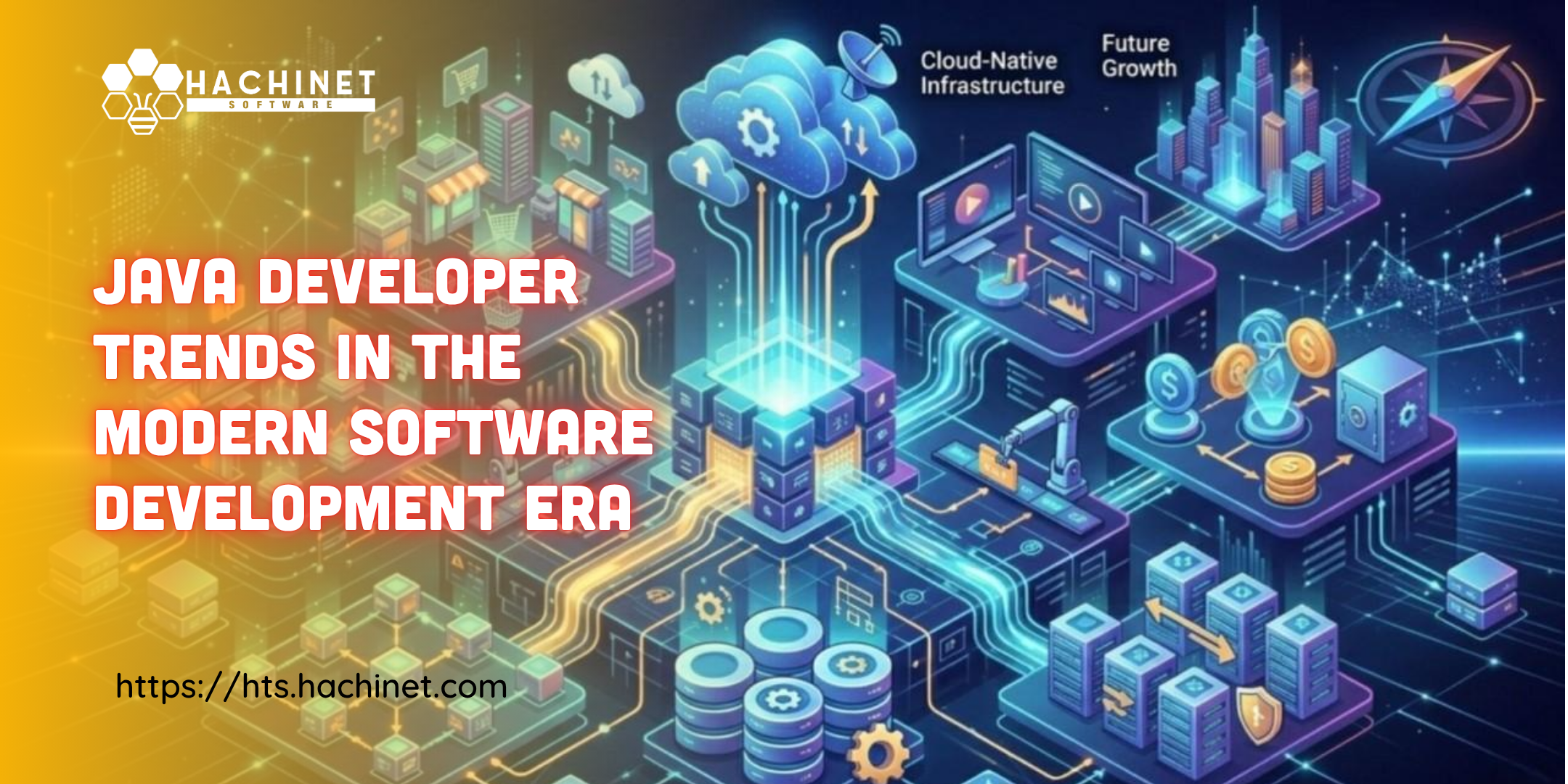
For many years, Java has remained one of the most important programming languages in enterprise systems, especially in industries such as finance, banking, e-commerce, insurance, logistics, and internal management systems.
However, the role of Java Developers has changed significantly. In the past, Java Developers mainly focused on writing backend code, handling business logic, and working with databases. Today, businesses expect much more: understanding system architecture, working with cloud platforms, optimizing performance, securing APIs, supporting CI/CD, and collaborating effectively in modern software development processes.
Java is not outdated. Java is evolving to better meet the needs of large-scale, stable, and scalable systems.
1. Java is becoming more modern, concise, and optimized
One of the most notable changes in Java in recent years is that the language is no longer as “verbose” as it used to be. New Java versions continue to introduce improvements that make code easier to read, easier to maintain, and better suited for high-performance systems.
Features such as records, pattern matching, switch expressions, virtual threads, and JVM-related improvements give Java Developers more tools to build modern applications.
This is especially important for businesses operating large systems, where stability, performance, and maintainability are always top priorities.
2. Java backend development is shifting strongly toward cloud-native
In the past, many Java systems were built and deployed using a monolithic model, where the entire application was developed and operated as one large block. This model is still suitable for some systems, but when businesses need faster scaling, frequent updates, and more flexible deployment, cloud-native becomes an inevitable trend.
Today’s Java Developers need to understand concepts such as microservices, containers, Docker, Kubernetes, API Gateway, service discovery, and configuration management.
Frameworks such as Spring Boot continue to play an important role in Java backend development, especially for systems that need to build APIs, microservices, and integrations with multiple platforms.
With this trend, Java Developers do not only write business logic. They also need to understand how applications are packaged, deployed, monitored, and operated in cloud environments.

3. Microservices require developers to understand system architecture better
Microservices help businesses break large systems into smaller independent services that are easier to develop, deploy, and scale. However, this model also increases complexity in design and operations.
A Java Developer working with microservices needs to understand REST API design, service-to-service communication, error handling, retries, timeouts, logging, monitoring, and distributed data management.
In addition, topics such as transactions in distributed systems, message queues, event-driven architecture, and security between services have become important skills.
This makes the role of Java Developers closer to that of well-rounded Software Engineers, rather than simply people who receive tasks and write code based on requirements.

4. Event-driven architecture is becoming more popular
As enterprise systems grow larger, direct communication between services through APIs is sometimes no longer flexible enough. Event-driven architecture is becoming an important trend, especially in systems that need real-time data processing or involve many complex business flows.
Technologies such as Kafka, RabbitMQ, and other message broker platforms are commonly used to help systems process events, synchronize data, and reduce dependencies between services.
For Java Developers, understanding event-driven architecture helps them build systems that are more scalable, more resilient under heavy load, and more flexible when business requirements change.
5. DevOps is no longer only the responsibility of DevOps Engineers
In modern projects, the boundary between Developers and DevOps is becoming closer. Java Developers do not necessarily need to become DevOps Engineers, but they should understand basic concepts such as CI/CD, deployment environments, logs, monitoring, and release processes.
A developer who can read logs, analyze issues in staging or production environments, understand build/deploy pipelines, and collaborate well with DevOps can help projects operate more effectively.
Businesses today highly value developers who not only write good code but also understand the full software lifecycle: from development and testing to deployment and post-release monitoring.
6. API security has become a required skill
Java backend systems often handle important data and connect with many other systems. Therefore, security cannot only be checked at the end of a project.
Modern Java Developers need to understand basic security principles such as authentication, authorization, JWT, OAuth2, data encryption, user permission management, API protection, and prevention of common vulnerabilities.
As systems scale, even one poorly designed API can create major data and operational risks. That is why secure coding mindset is becoming an important requirement for backend teams.

7. AI supports developers but does not replace technical thinking
AI tools are helping developers write code faster, suggest solutions, generate test cases, explain errors, and optimize certain code segments. This helps developers save time on repetitive tasks.
However, AI cannot replace system design thinking, business understanding, technical risk assessment, and responsibility for product quality.
For Java Developers, an important skill in the coming period is not only knowing how to use AI to write code faster, but also knowing how to review, evaluate, and use AI as a supporting tool in the software development process.
8. Java Developers need to grow toward “understanding the system”
Java Developer hiring trends are changing. Businesses are no longer looking only for people who know Java, Spring Boot, and SQL. They need professionals who can understand systems, analyze problems, collaborate with teams, and contribute to product improvement.
A strong Java Developer today often needs to combine multiple skills:
- Strong knowledge of Java core and OOP.
- Experience with Spring Boot or popular backend frameworks.
- Understanding of REST API, databases, and caching.
- Knowledge of microservices and message queues.
- Basic understanding of cloud, Docker, and CI/CD.
- Security mindset and performance optimization skills.
- Ability to use AI tools with proper control.
- Good communication with BAs, Testers, DevOps, and other project members.
This is why businesses increasingly prioritize developers with practical experience, an understanding of software development processes, and the ability to adapt to new technologies.
Conclusion
Java still plays an important role in enterprise systems, but modern Java Developers need more than coding skills. Software development trends now require developers to understand backend architecture, cloud-native systems, microservices, DevOps, API security, and how to apply AI in their work.
In the coming period, Java Developers who can combine a strong technical foundation with system thinking will have more opportunities in large technology projects.
For businesses, building or supplementing the right Java Developer team not only helps accelerate product development, but also contributes to ensuring that systems operate stably, securely, and are ready to scale in the future.