.png)
In recent years, AI (Artificial Intelligence) and Machine Learning (ML) have been increasingly widely adopted by businesses, from data analysis and demand forecasting to image recognition, chatbots, and recommendation systems.
However, building a highly accurate Machine Learning model is only the first step. To deploy a model in a real-world environment, ensure stable operation, continuously update data, and monitor performance, businesses need a well-structured management process. This is why MLOps has become an important component of AI deployment.
So, what is MLOps? What role does MLOps play in AI deployment? Let’s explore these questions in the following article.
1. What is MLOps?
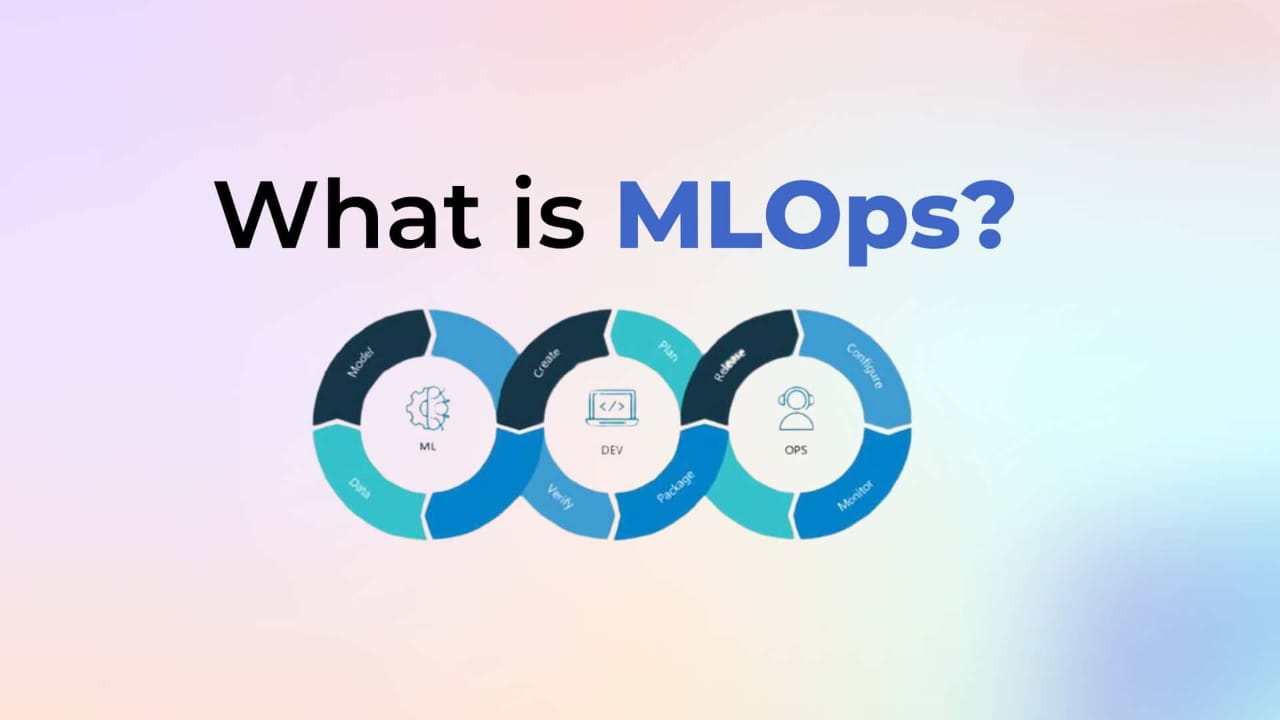
MLOps (Machine Learning Operations) is a set of practices, processes, and tools used to manage the entire lifecycle of a Machine Learning model, from development and training to deployment, monitoring, and model updates.
MLOps can be understood as a combination of:
- Machine Learning (ML): Building and developing AI models.
- DevOps: Automating software development, testing, and deployment processes.
- Data Engineering: Collecting, processing, and managing data for Machine Learning.
While Data Scientists focus on building models, MLOps ensures that these models can be effectively deployed and operated in real-world environments.
A typical MLOps process includes:
Data → Training → Validation → Deployment → Monitoring → Retraining
This process forms a continuous loop that enables models to be improved as data and business requirements change.
2. Why Do Businesses Need MLOps?
During the experimentation stage, a Data Scientist can easily build and evaluate a Machine Learning model in a local environment or notebook.
However, once the model is deployed to production, various issues may arise:
- Input data changes over time.
- Model performance deteriorates.
- Models need to be retrained periodically.
- Managing multiple model versions becomes difficult.
- Manual deployment processes are time-consuming.
- Monitoring model errors and performance is challenging.
- Development and production environments are not consistent.
- Rolling back to a previous model version can be complicated.
This is often referred to as the “Machine Learning gap” between building a model in a research environment and operating that model at scale in a real-world environment.
MLOps helps businesses address these challenges by incorporating automation, version control, CI/CD, and monitoring practices into the Machine Learning lifecycle.
3. How is MLOps Different from DevOps?
MLOps and DevOps share many similarities because both aim to automate, standardize, and optimize the processes of developing, deploying, and operating systems. However, the objects managed by these two approaches are different.
DevOps primarily focuses on the software lifecycle, from source code development and testing to deployment and application monitoring. In contrast, MLOps is specifically designed for Machine Learning, meaning that in addition to code, it also needs to manage data, models, and the training process.
Some key differences between MLOps and DevOps include:
- Management scope: DevOps primarily focuses on source code and applications, while MLOps needs to simultaneously manage code, datasets, ML models, and experiments.
- CI/CD process: In DevOps, CI/CD generally focuses on building, testing, and deploying source code. In MLOps, the process can also include data validation, model training, model evaluation, and model deployment.
- Version control: DevOps primarily uses version control for source code. MLOps also needs to track dataset and model versions, as changes in data can directly affect model results.
- Monitoring: DevOps typically monitors metrics such as servers, application performance, CPU, memory, latency, and error rates. In addition to system metrics, MLOps also needs to monitor model performance, data quality, data drift, and model drift.
- System updates: For conventional software, updates are typically performed when a new code version is released. For Machine Learning, models may need to be retrained and updated periodically when data or user behavior changes.
In simple terms, DevOps helps businesses operate software efficiently, while MLOps extends these principles to manage the entire lifecycle of Machine Learning models.
Therefore, MLOps does not replace DevOps but is often combined with DevOps to create a comprehensive process for AI/ML systems. In a real-world AI project, DevOps may be responsible for infrastructure and application deployment, while MLOps focuses more deeply on data, model training, model deployment, and model monitoring.
4. The Role of MLOps in AI Deployment

4.1. Automating the AI Deployment Process
One of the most important roles of MLOps is to automate the process of moving models from the development environment to production.
Instead of requiring Data Scientists to manually perform multiple steps, MLOps can build a pipeline to automatically:
- Collect data.
- Clean and preprocess data.
- Train the model.
- Evaluate the model.
- Check deployment conditions.
- Deploy the model.
- Monitor the model.
- Retrain the model when necessary.
This helps businesses shorten the time required to move a model from development to production.
4.2. Managing Model and Dataset Versions
In an AI project, a business may have dozens or even hundreds of model versions.
For example:
- Model v1 achieves 85% Accuracy.
- Model v2 achieves 89% Accuracy.
- Model v3 achieves 91% Accuracy.
Without a clear version management mechanism, it can become difficult to determine which model is currently being used, which dataset was used to train the model, or whether it is possible to roll back to a previous version.
MLOps helps manage:
- Source code.
- Dataset.
- Model.
- Configuration.
- Experiment.
- Model metadata.
This makes the AI development process more transparent and traceable.
4.3. Continuous Integration and Continuous Delivery for Machine Learning
MLOps applies CI/CD principles to Machine Learning.
In a typical process, whenever there is a change to the code, data, or model, the system can automatically perform:
Build → Test → Train → Evaluate → Deploy
For example, when a new dataset is updated, the pipeline can automatically retrain the model and evaluate whether the new model performs better than the current one.
If the predefined criteria are met, the new model will be deployed to production.
4.4. Monitoring Model Performance
A model may perform well when it is first deployed, but its performance does not necessarily remain consistent over time.
This may be caused by changes in real-world data.
For example, an AI system designed to predict customer behavior may be trained using data from 2025. When user behavior changes in 2026, the model may begin to produce less accurate predictions.
MLOps helps businesses monitor:
- Model performance.
- Prediction accuracy.
- Data quality.
- Data distribution.
- Latency.
- Resource usage.
- Error rate.
This enables businesses to detect potential issues early and take appropriate corrective actions.
5. Data Drift and Model Drift in MLOps
These are two important concepts when operating Machine Learning models.
5.1. Data Drift
Data Drift occurs when the distribution of input data changes compared to the data used to train the model.
For example, a model may be developed to predict purchasing demand based on customers aged 18–35. After a period of time, the proportion of customers from other age groups may increase significantly.
The new data is no longer similar to the original training data, which can affect prediction results.
5.2. Model Drift
Model Drift occurs when model performance deteriorates over time because the relationship between input data and output results has changed.
When drift is detected, an MLOps system can trigger the following process:
Detect Drift → Collect New Data → Retrain → Evaluate → Deploy
This allows the model to be continuously updated instead of being trained only once and then used for an extended period.
6. Benefits of MLOps for Businesses
Applying MLOps provides numerous benefits for businesses deploying AI.
- Faster Deployment: Automation significantly reduces manual tasks, thereby shortening the time required to move a model into production.
- Improved Stability: Standardized deployment and testing processes help reduce the risk of errors during deployment.
- Easier Scalability: As the number of models and AI applications increases, MLOps helps businesses manage them through a unified process.
- Easier Control and Traceability: Version management for code, data, and models enables businesses to understand exactly how the model currently in use was created.
- Reduced Operational Costs: Automation reduces manual work and minimizes the time technical teams need to spend handling issues.
- Maintained AI Performance: Monitoring and retraining allow models to be updated when real-world data changes.
7. MLOps and the Future of AI Deployment
The development of Generative AI, Large Language Models (LLMs), and AI Agents is driving continued changes in MLOps requirements.
In addition to traditional Machine Learning models, businesses increasingly need to manage:
- LLMs.
- Prompts.
- Embeddings.
- Vector Databases.
- RAG pipelines.
- AI Agents.
- Model evaluation.
- AI application monitoring.
This has led to the development of concepts such as LLMOps and GenAIOps, which extend MLOps principles to Generative AI systems.
In the future, MLOps will not only support Data Scientists in deploying models but will also become an important part of AI Engineering and AI infrastructure within businesses.
Conclusion
What is MLOps? Simply put, MLOps is a set of processes and tools that help businesses systematically build, deploy, manage, and monitor Machine Learning models.
While Machine Learning focuses on creating models capable of making predictions, MLOps focuses on the question: How can these models operate reliably, continuously improve, and scale in real-world environments?
With the rapid development of AI, building a good model is no longer enough. Businesses need an effective AI operations system capable of automation, monitoring, and continuous updates. This is the important role of MLOps in bringing AI from the lab to production.