.png)
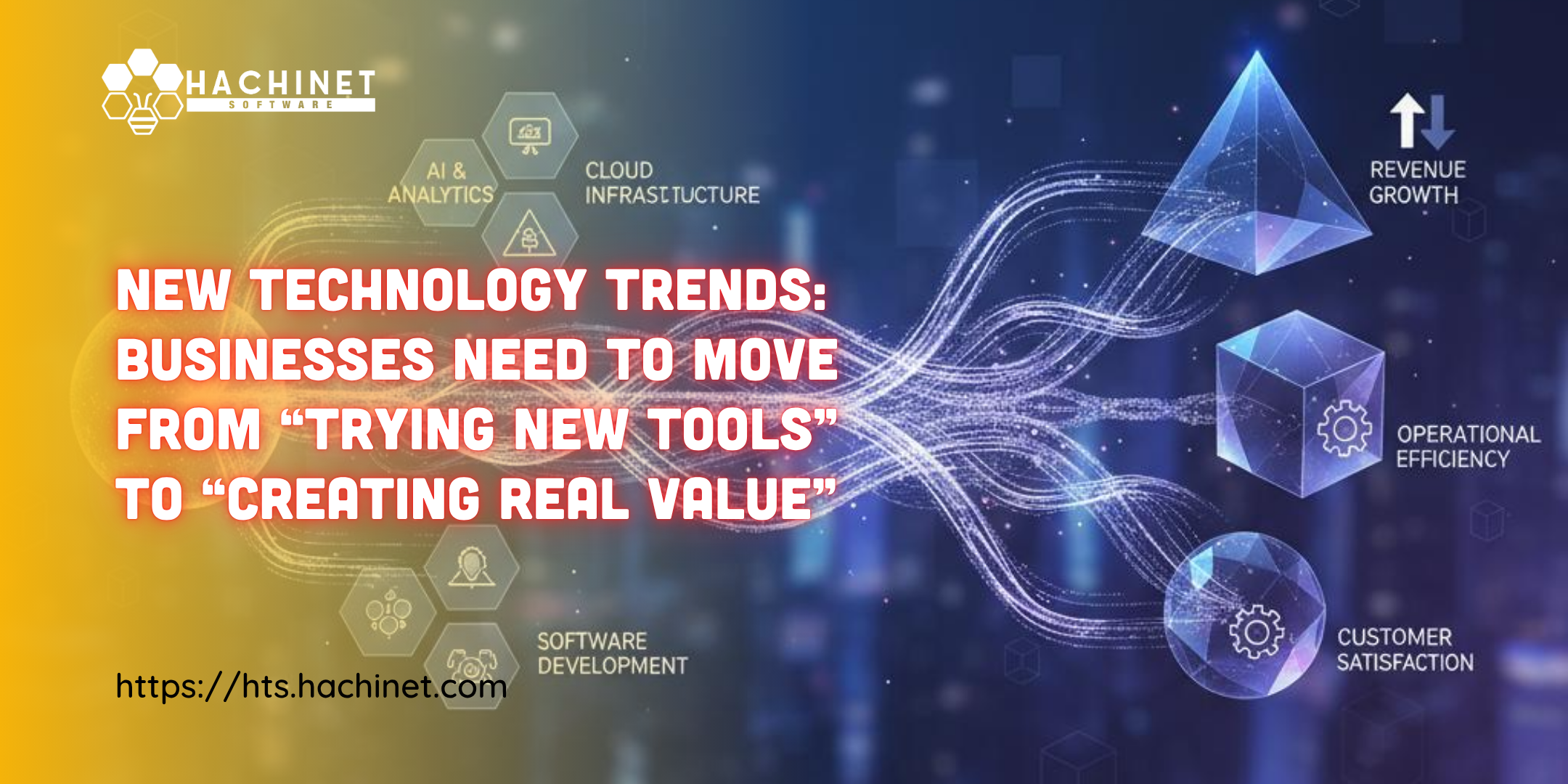
Technology is changing faster than ever. In the past, businesses mainly focused on adopting new technologies to keep up with market trends. Today, however, the more important question is: does this technology create real value for the business?
In an increasingly competitive market, businesses can no longer invest in technology simply because it is popular. Every solution should be connected to a specific goal, such as optimizing operations, accelerating product development, reducing costs, improving customer experience, or enhancing decision-making capabilities.
Below are some key technology trends that are strongly influencing how businesses build, operate, and develop their systems in the near future.

1. AI is no longer just a support tool, but part of the workflow
AI is gradually moving from being a standalone support tool to becoming more deeply integrated into business operations. Instead of using AI only to create content, answer questions, or perform basic data analysis, many businesses are beginning to apply AI to repetitive processes that require fast information processing and a high level of automation.
For example, AI can support customer request classification, document summarization, sales data analysis, work recommendation, or assist engineering teams during software development.
The important point is that businesses need to identify the right problem before implementing AI. Not every process needs AI, and adding AI to a system does not automatically create efficiency. Real value only appears when AI is integrated into the right process, supported by suitable data, and managed with clear control mechanisms.
2. AI Agents are opening up a new way of working
One emerging trend that is receiving significant attention is AI Agent technology. AI Agents are systems that can perform multiple steps of work based on a given objective. Instead of simply responding to individual requests, an AI Agent can help plan tasks, collect information, analyze data, and suggest the next actions.
In businesses, AI Agents can be applied to customer service, internal support, knowledge management, report analysis, system checking, or automation of certain operational tasks.
However, AI Agents also require a higher level of governance. Businesses need to control data access rights, scope of action, result accuracy, and responsibility when the system provides incorrect recommendations. Therefore, this trend is not only about technology, but also about management processes and security.
3. Software development is being accelerated by AI
AI is changing the way technology teams develop software. Programming support tools can suggest code, detect bugs, write technical documentation, assist with testing, and help developers complete certain tasks more quickly.
This does not mean AI will completely replace developers. On the contrary, the role of technical teams will shift toward focusing more on architecture design, solving complex problems, ensuring system quality, and making appropriate technical decisions.
In the near future, software development productivity will not depend only on the number of team members, but also on the ability to combine human expertise, AI tools, and effective workflows.
4. Security must be designed from the beginning
As businesses adopt more new technologies, security risks also increase. Data is shared across more systems, employees work on more platforms, and AI tools may access multiple sources of important information.
Therefore, security should not be treated as a final checkpoint after the system has been completed. Businesses need to include security from the design, development, and operation stages.
Issues such as access control, data protection, system activity monitoring, vulnerability testing, and regulatory compliance should be considered part of the overall technology strategy. This is the foundation that helps businesses develop digital products in a more sustainable and secure way.

5. Data must be organized to support faster decision-making
Businesses today have a large amount of data, but not all of it is ready to use. One major challenge is that data is scattered across different systems, lacks standardization, or has not been effectively utilized.
In the coming period, businesses will need to focus more on building data platforms that are clearly structured, easy to access, and able to support analysis, reporting, automation, and AI applications.
Data does not only serve the technical team. It also supports departments such as sales, marketing, operations, finance, and customer service in making faster and more accurate decisions.

6. Technology cost optimization is becoming a priority
As businesses use more platforms, tools, and technology infrastructure, operational costs also increase. As a result, optimizing technology costs while maintaining performance and scalability has become an important trend.
Businesses need to reassess their use of system resources, cloud costs, software costs, operational costs, and the effectiveness of each technology investment. The goal is not to cut costs at all costs, but to use technology resources in the right place, for the right need, and at the right time.
An effective technology system should not only be technically strong, but also cost-efficient and aligned with business goals.
7. People remain the decisive factor for success
No matter how quickly technology develops, people remain the central factor in every digital transformation project. Businesses need teams that can understand business problems, select suitable technologies, implement systems, manage risks, and continuously optimize operations.
As technology continues to change, the skills required of IT professionals must also evolve. They should not only know a specific programming language or tool, but also be able to learn quickly, adapt to new technologies, collaborate with different departments, and understand the business goals of each project.
Businesses that can effectively combine technology, data, processes, and people will have a stronger advantage in creating products, services, and operating models that deliver real value.
Conclusion
Today’s technology trends are no longer just about whether businesses use the latest technologies. What matters more is whether businesses can apply those technologies to the right problems.
AI, AI Agents, AI-assisted software development, security, data, and technology cost optimization are all creating major changes. However, real value only comes when businesses have a clear strategy, suitable processes, and a capable team to execute effectively.
In the coming period, businesses need to shift from the mindset of “trying new technology” to “creating real value from technology.” This will be an important factor in helping companies strengthen competitiveness and achieve sustainable growth in the digital era.